
Valuing a business is the process of working out what it is realistically worth, based on its profit, its assets and what similar businesses have sold for. In Australia, most small businesses are valued using a multiple of their adjusted profit (known as SDE), cross-checked against comparable sales and the value of their assets. Whether you are buying, selling or simply planning ahead, understanding how a valuation works puts you in control of one of the most important numbers in business.
This guide explains how to value a business in Australia from start to finish: the five main valuation methods, the formulas behind them, how to calculate your true earnings, the step-by-step process, what raises or lowers value, and the mistakes to avoid. By the end, you will be able to estimate any business's worth with confidence.
Want a quick figure first? Try our free business valuation calculator, then read on to understand exactly what sits behind the number.
What does it mean to value a business?
Valuing a business means estimating the price a willing buyer would pay a willing seller for it. It is not a single fixed number but a well-supported estimate, built from the business's earnings, its tangible and intangible assets, and the current market. A good valuation gives you a defensible range rather than one exact figure, because the final price is always settled through negotiation.
You might need a business valuation for several reasons: selling your business, buying one, bringing in or buying out a partner, applying for finance, succession or estate planning, or a legal or tax matter. The purpose shapes how formal the valuation needs to be. A quick estimate is fine for early planning, while a sale, finance application or legal case usually calls for a professional, defensible valuation. Either way, the fundamentals below are the same.
How do you value a business? The 5 main methods
There are five main methods used to value a business in Australia: market comparison, the earnings multiple (SDE) method, the EBITDA multiple method, the asset-based method, and capitalised future earnings. Most valuations combine two or three of these to arrive at a defensible figure, because each method captures a different part of a business's worth.
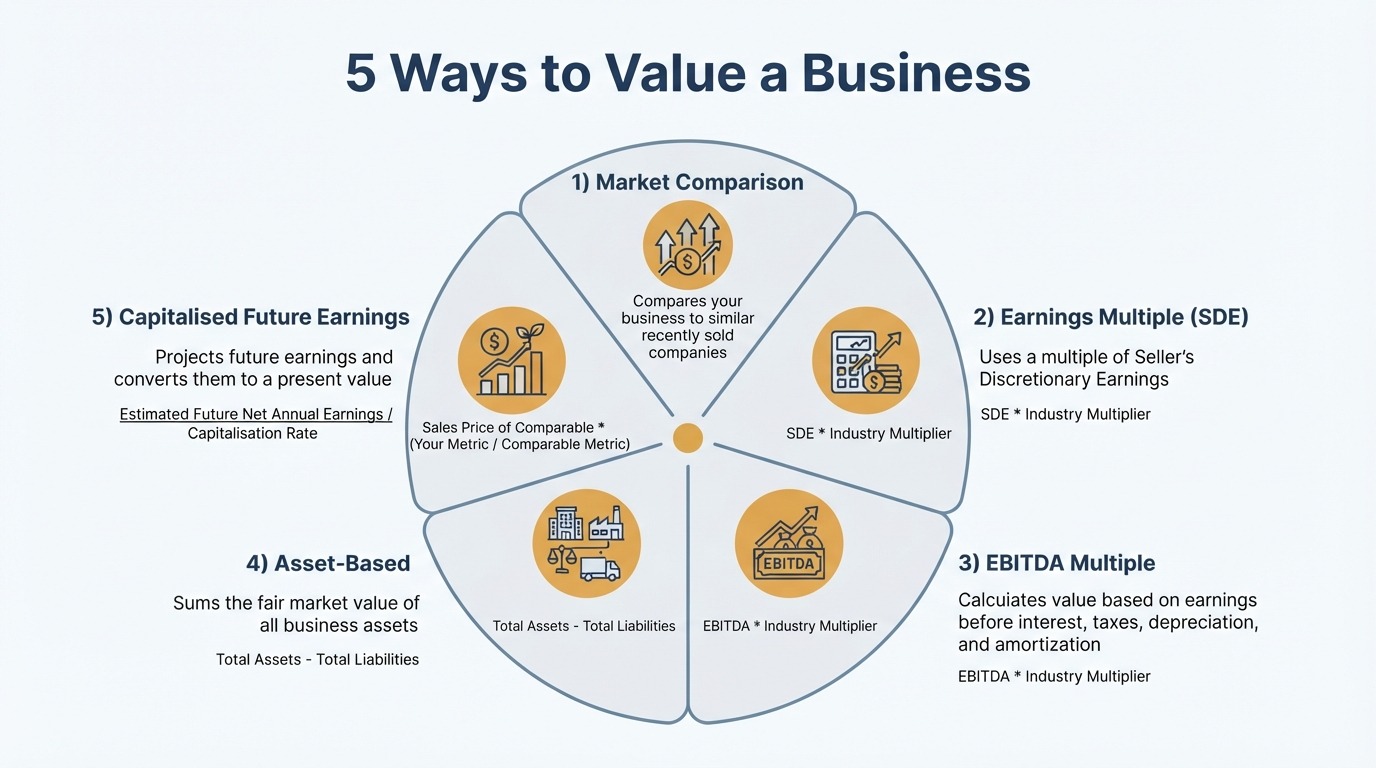
Here is how each method works.
Market comparison. This benchmarks your business against recent sales of similar businesses in the same industry and area. It is the reality check every other method should be tested against, because it reflects what buyers are actually paying. The challenge is finding genuinely comparable sales, since private business sale prices are not always public. You can gauge the market by browsing comparable businesses for sale.
Earnings multiple (SDE method). This is the standard method for small, owner-operated businesses. You take the business's adjusted annual profit, called Seller's Discretionary Earnings (SDE), and multiply it by an industry multiple. It works because a buyer is essentially paying for the income the business will generate for them.
EBITDA multiple. Used for larger or more structured businesses, this applies a multiple to earnings before interest, tax, depreciation and amortisation. EBITDA strips out financing and accounting decisions to show the underlying operating performance, which suits businesses with managers rather than a single owner-operator.
Asset-based (net asset value). This adds up the business's tangible and intangible assets, then subtracts its liabilities. It is straightforward, but on its own it usually undervalues a profitable business because it ignores future earning potential. It is most relevant for asset-heavy or underperforming businesses.
Capitalised future earnings. This places a present-day value on the profit the business is expected to generate in future, by dividing its maintainable earnings by a capitalisation rate that reflects risk. It suits businesses with strong, predictable earnings and clear growth prospects.
What is SDE and how do you calculate it?
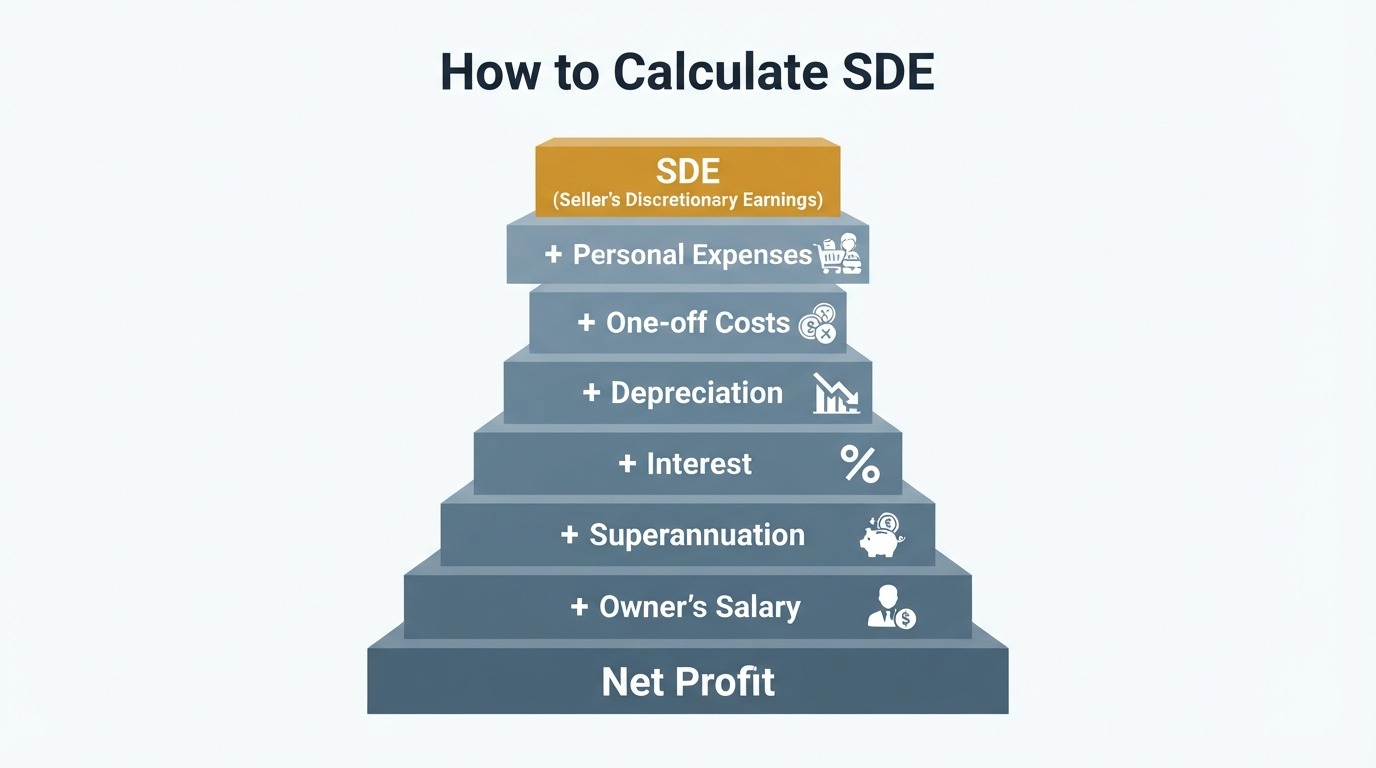
SDE, or Seller's Discretionary Earnings, is the true financial benefit a business delivers to a single owner-operator in a year. You calculate it by starting with the business's net profit and adding back the owner's salary, superannuation, one-off costs, interest, depreciation and any personal or discretionary expenses run through the business. SDE reveals the real earning power that a valuation multiple is applied to.
This is the concept most first-time buyers and sellers miss, and it matters enormously. A business might show a small net profit on paper, yet deliver a much larger real benefit to its owner once you add back everything that is discretionary or non-essential. Those "add-backs" are legitimate, but they must be genuine and verifiable, not wishful.
 .
.
Common add-backs when calculating SDE:
The owner's salary or wages and superannuation
Interest on business loans
Depreciation and amortisation
One-off or non-recurring expenses (a legal dispute, a major repair)
Personal expenses run through the business (vehicle, travel, phone)
Discretionary owner perks that a new owner would not need to spend
Add these to net profit and you have SDE, the figure your valuation multiple is applied to.
What is the formula to value a business?
The most common business valuation formula in Australia is: Business Value = SDE x Industry Multiple. For example, a business with $150,000 in adjusted profit (SDE) and a multiple of 2.5 would be worth around $375,000. Other formulas include the EBITDA multiple for larger businesses, the asset-based formula, and the ROI formula, each suited to different situations.
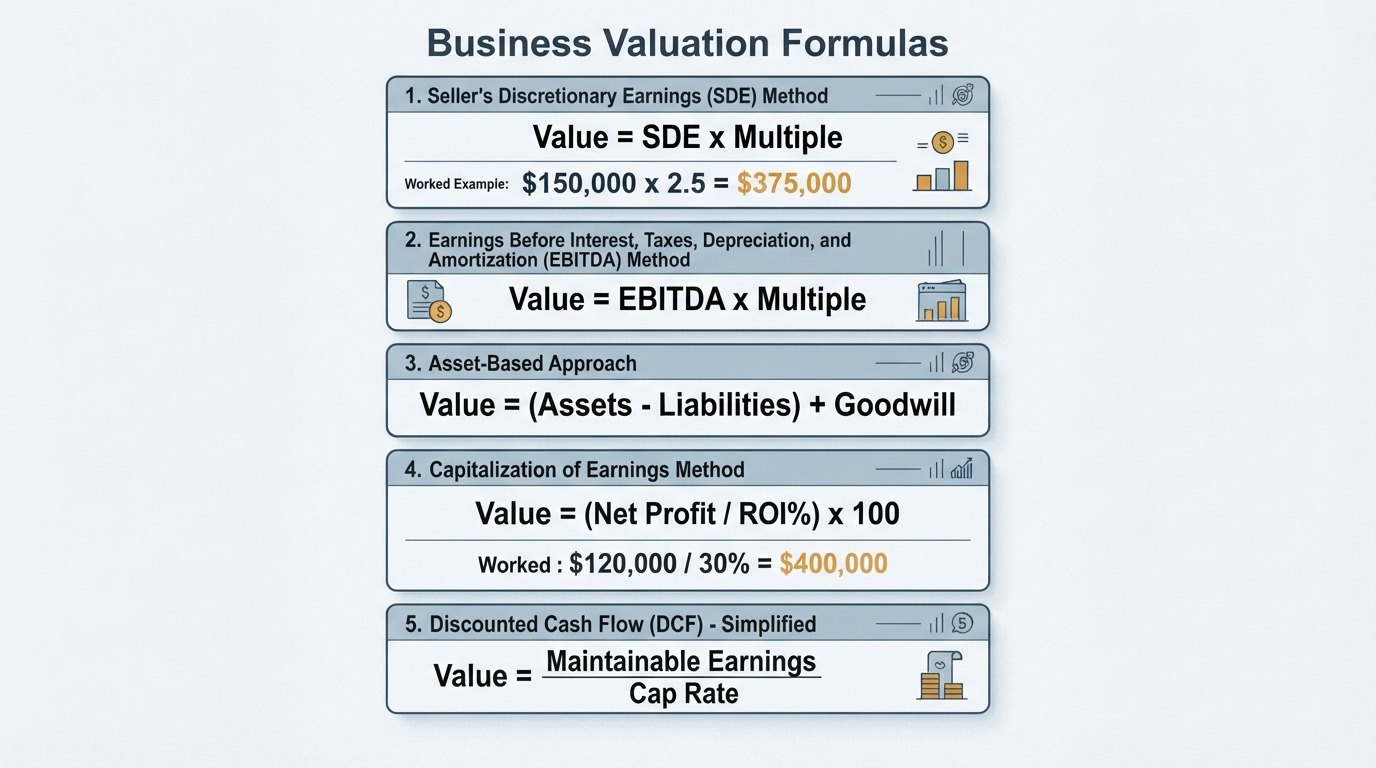
The key formulas explained:
Earnings multiple: Business Value = SDE x Multiple. The workhorse formula for small business. A cafe with $120,000 SDE and a 2x multiple is worth around $240,000.
EBITDA multiple: Business Value = EBITDA x Multiple. Used for larger businesses run by managers rather than owners.
Asset-based: Business Value = (Total Assets minus Total Liabilities) plus Goodwill.
ROI method: Business Value = (Net Annual Profit divided by desired ROI percentage) x 100. A buyer wanting a 30 percent return on a business earning $120,000 would value it at around $400,000.
Capitalised earnings: Business Value = Future Maintainable Earnings divided by the Capitalisation Rate.
For a real-world walk-through of these formulas in action, see our Melbourne restaurant valuation example.
How to value a business step by step
To value a business step by step, gather at least three years of financial records, calculate the adjusted profit (SDE), choose a realistic industry multiple, apply the valuation formula, add the value of any assets or stock not reflected in earnings, then cross-check the result against comparable sales and adjust for risk. Finishing with a professional review gives you a defensible final figure.
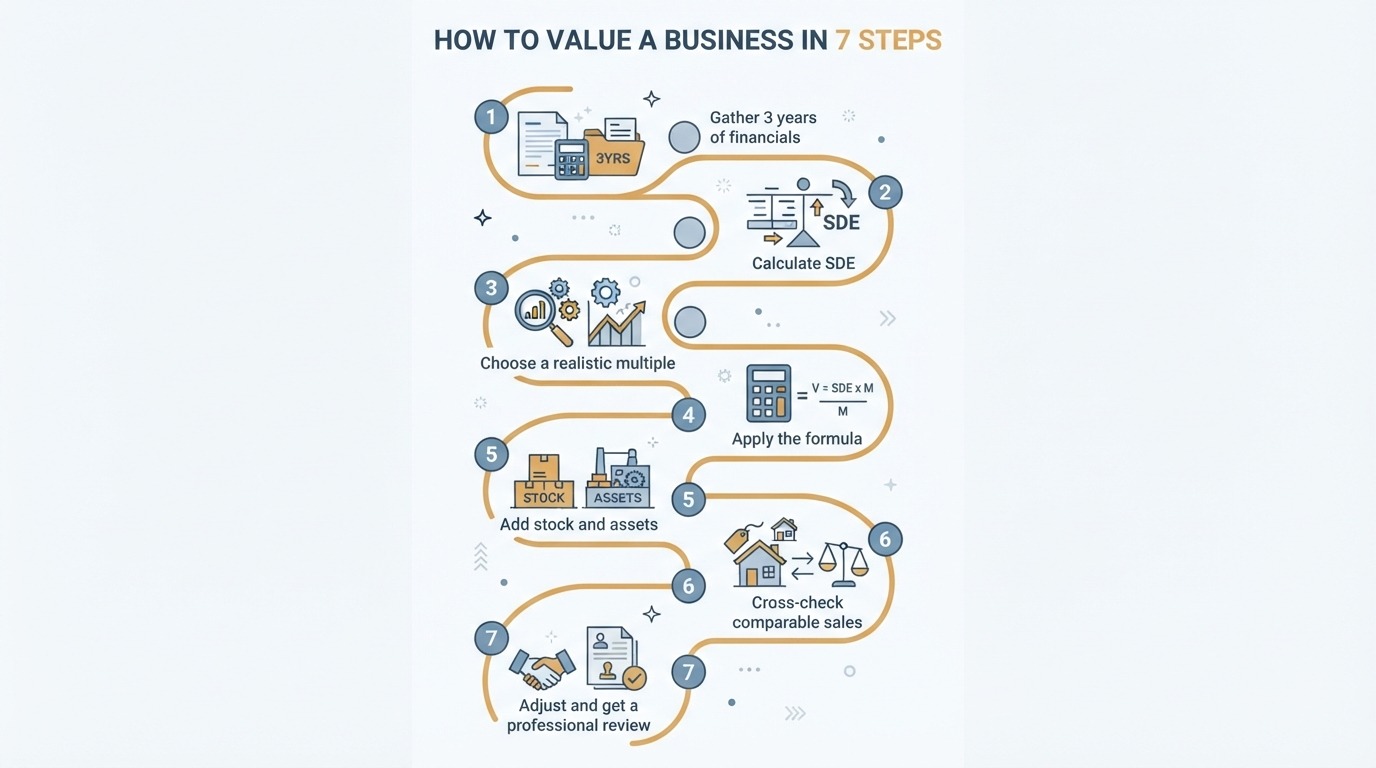
The full process:
Gather the financials. Collect at least three years of profit and loss statements, balance sheets, tax returns and BAS. Consistency across years builds buyer confidence.
Calculate SDE. Work out the adjusted profit using the add-backs above.
Choose a realistic multiple. Base it on the industry, size, growth and risk of the business.
Apply the formula. Multiply SDE by the multiple to get a base value.
Add separate assets and stock. Stock at valuation and major equipment not reflected in earnings are usually added on top.
Cross-check with comparable sales. Test your figure against what similar businesses have sold for.
Adjust and review. Factor in risk, then have an accountant or certified valuer sanity-check the result.
Our free valuation calculator automates the core of this process so you can get an instant estimate before doing the detailed work.
What multiple should you use to value a business?
Most small businesses in Australia are valued at a multiple of around 1.5 to 3 times SDE, though this varies widely by industry. Service and trades businesses with recurring revenue often sit at the higher end, retail and hospitality typically in the middle, and asset-light or high-growth businesses can attract more. Larger businesses are usually valued on an EBITDA multiple of roughly 3 to 6 times. The stronger and lower-risk the business, the higher the multiple.
The multiple is really a measure of risk and desirability. A business earns a higher multiple when its profit is consistent and growing, its revenue is recurring, it runs without the owner, and its future looks bright. It attracts a lower multiple when it depends heavily on the owner, relies on one or two big customers, has messy books or a short lease, or sits in a shrinking market. Treat any published multiple as a starting point, then adjust up or down for the specific business.
What factors affect a business's value?
A business's value is driven up by consistent and growing profit, recurring revenue, a diverse customer base, low reliance on the owner, strong systems, clear growth potential, clean financial records, a secure lease and a strong brand. Value is dragged down by declining sales, heavy owner-dependence, customer concentration, disorganised books, a short lease, legal issues or a shrinking industry.
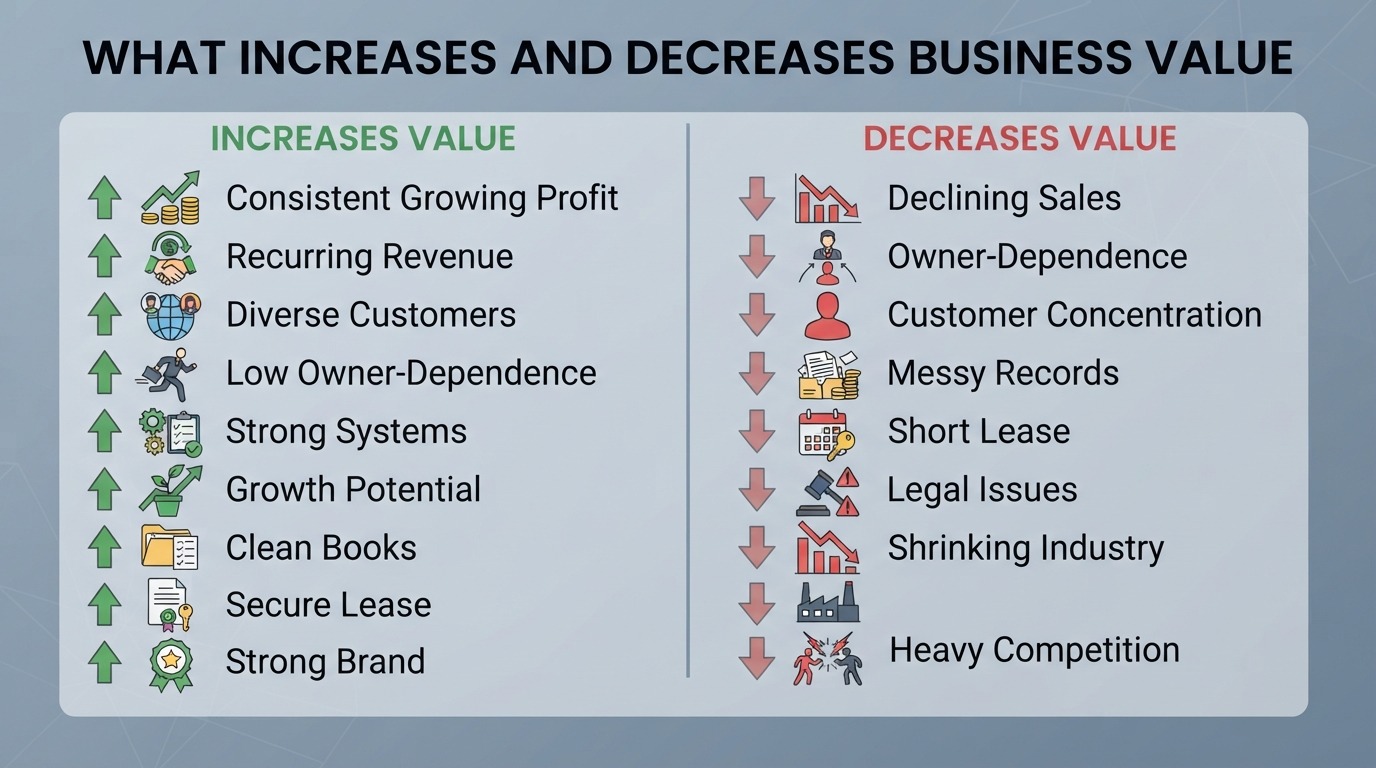
The single biggest lever is reducing how much the business depends on you. A business that runs on documented systems and a capable team is worth far more than one that only works because the owner is there every day, because the buyer is purchasing a business, not a job. If you are preparing to sell, our guide on what to know when selling a business covers how to strengthen these value drivers before you list.
What are the most common business valuation mistakes?
The most common business valuation mistakes are valuing a business on turnover instead of profit, using an unrealistic multiple, ignoring or overstating SDE add-backs, overlooking owner-dependence, forgetting to value stock and assets separately, and letting emotion inflate the price. Each of these leads to a figure that buyers or the market will not support.
The mistakes to avoid:
Valuing on turnover, not profit. Revenue means little until costs are accounted for. Value follows profit.
Using the wrong multiple. Applying a high-growth multiple to a flat business inflates the price unrealistically.
Mishandling add-backs. Missing legitimate add-backs undervalues the business; inventing them destroys buyer trust.
Ignoring owner-dependence. A business that cannot run without the owner deserves a lower multiple.
Forgetting stock and assets. These are usually added on top of the earnings-based value, not baked into it.
Letting emotion set the price. Years of hard work are real, but buyers pay for numbers, not sentiment.
Should you use a free calculator or a professional valuer?
Use a free business valuation calculator for an instant estimate when you are exploring your options, planning ahead or setting a rough asking price. Use a professional valuer, such as a certified business valuer or your accountant, when you need a formal, defensible figure for a sale, finance application, partnership buyout or legal matter. The smart approach is to start with the calculator, then commission a professional valuation once you are serious.
A DIY estimate is perfect for early planning and pricing conversations, and it costs nothing. A professional valuation adds credibility and industry-specific insight when real money or legal outcomes depend on the number. The two work together rather than competing. Begin with the free calculator to get your bearings, then bring in an expert when the figure needs to stand up to scrutiny.
How to use Exity's free business valuation calculator
To use the calculator, enter your business's financial details, including revenue, adjusted profit, assets and industry, and it applies standard valuation methods to return an instant estimate of your business's worth. It is free, takes a few minutes, and gives you a realistic starting figure before you list your business or speak to a valuer.
Have your recent profit and loss figures ready, add back the owner's salary and any one-off or personal expenses to find your true SDE, and let the tool handle the calculations. It is the fastest way to answer "how much is my business worth" without spreadsheets. When you are ready, get your free business valuation here. For a shorter, seller-focused overview, see our companion guide on how much your business is worth.
The bottom line
Valuing a business comes down to a simple idea: work out its true earnings, apply a realistic multiple, add the value of its assets, and test the result against what real buyers are paying. Focus on the levers that matter most, clean financials, recurring revenue and low owner-dependence, and you will not only value your business accurately but also make it worth more. Start with a free estimate, understand the methods behind it, and bring in a professional when the number really counts.
Ready to find out what your business is worth? Get your free business valuation, and when you are ready, list your business for sale on Exity or browse businesses for sale to benchmark against the market.
Frequently asked questions
How do you value a business in Australia? You value a business by calculating its adjusted profit (SDE), applying a realistic industry multiple of around 1.5 to 3 times, adding the value of assets and stock, then cross-checking against comparable sales. Most valuations blend the earnings-multiple, asset-based and market-comparison methods. A free calculator gives an instant estimate, while a certified valuer provides a formal figure.
What is the formula to value a small business? The most common formula is Business Value = SDE x Industry Multiple. For example, $150,000 in adjusted profit at a multiple of 2.5 gives a value of about $375,000. Small owner-operated businesses typically use a multiple of 1.5 to 3 times SDE, which varies by industry, size, growth and risk.
What is SDE in a business valuation? SDE, or Seller's Discretionary Earnings, is the true financial benefit a business delivers to a single owner-operator in a year. It is calculated by taking net profit and adding back the owner's salary, superannuation, interest, depreciation, one-off costs and personal expenses run through the business. SDE is the figure that a valuation multiple is applied to.
How many times profit is a business worth? Small businesses in Australia are commonly valued at 1.5 to 3 times their adjusted annual profit (SDE), while larger businesses may be valued at 3 to 6 times EBITDA. The exact multiple depends on the industry, growth, recurring revenue and how dependent the business is on its owner. Always benchmark against comparable sales.
Is a free business valuation calculator accurate? A free calculator gives a useful, standards-based estimate that is ideal for early planning and setting a rough asking price. It cannot capture every nuance of your business, so for a formal, defensible figure for a sale, finance or legal purpose, you should also obtain a professional valuation from a certified business valuer or accountant.
How can I increase the value of my business before selling? Increase your business's value by growing and documenting consistent profit, building recurring revenue, reducing the business's reliance on you, tidying up your financial records, securing your lease and diversifying your customer base. Reducing owner-dependence is the single most effective way to lift both the multiple and the final sale price. Ideally start 12 months before selling