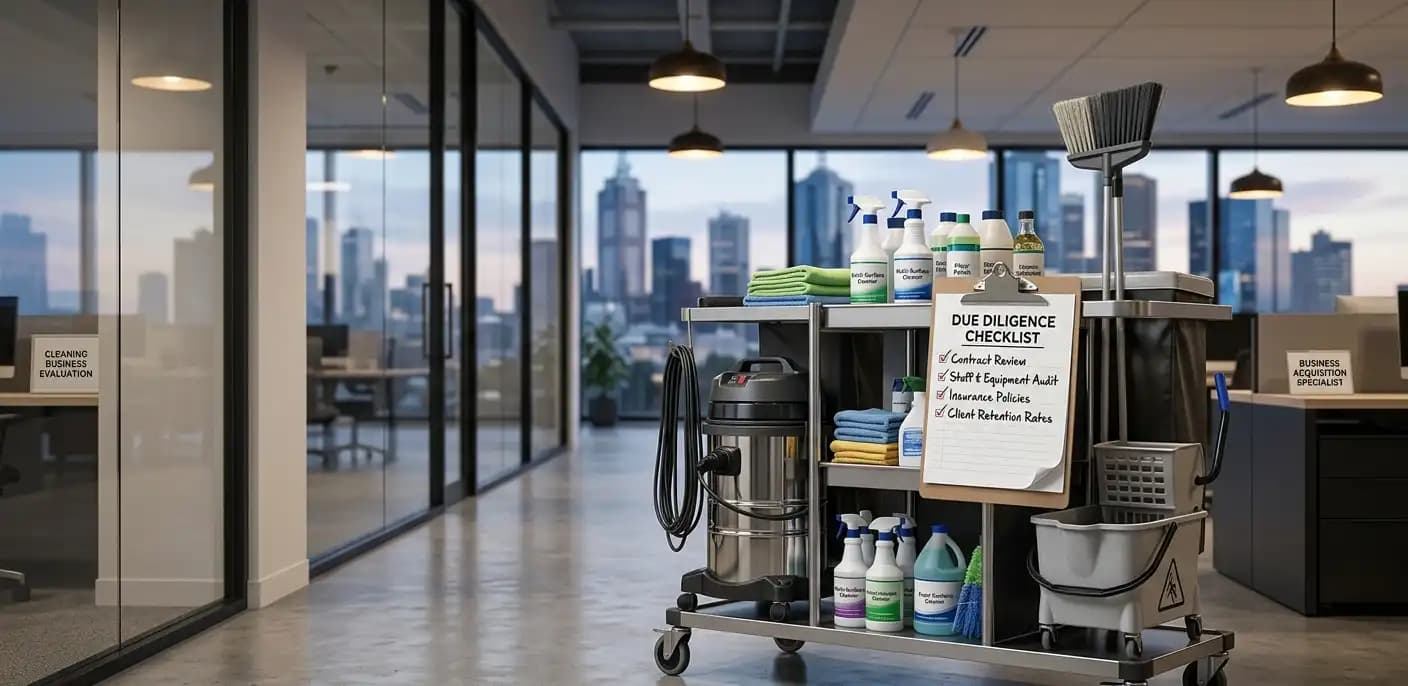
A cleaning business for sale can look like one of the simplest acquisitions on the market: low equipment costs, steady demand, and revenue that lands month after month. That picture is broadly accurate, which is why these listings attract both first-time buyers and experienced operators. What separates a sound purchase from an expensive lesson usually sits below the surface, in the contracts, the staffing model, and the way the current owner has reported the numbers.
This guide covers what to check before you commit to a cleaning business in Australia, whether you are searching in Melbourne, Sydney, Brisbane, or Perth. We look at the appeal, the independent versus franchise decision, how to read contract quality, how these businesses are valued, the due diligence that matters, and the costs that sit beyond the asking price.
Why Cleaning Businesses Appeal to Buyers
Cleaning is one of the few sectors where demand barely flinches through an economic cycle. Offices still need servicing, medical centres still need to meet hygiene standards, and households still book their regular cleans. That stability is the main reason a cleaning business for sale tends to move quickly when it is priced fairly.
Three features stand out for buyers:
• Recurring revenue. Most established cleaning businesses run on contracts or standing weekly and fortnightly bookings. Income is predictable, which makes cash flow easier to manage and finance easier to obtain.
• Low entry cost. Compared with hospitality or retail, equipment and fit-out costs are modest. You are buying client relationships and systems rather than a kitchen or a shopfront, so the capital at risk is lower.
• Scalability. Adding clients rarely means adding premises. A commercial cleaning business for sale can often take on new contracts simply by rostering more staff or subcontractors, which keeps overheads flat as revenue grows.
The flip side is that low barriers to entry also invite competition. Anyone can buy a vacuum and undercut on price, so the businesses worth buying are the ones with locked-in clients and a reputation that is hard to replicate.
Independent vs Cleaning Franchise
Cleaning businesses come in two broad shapes: independent operations built by the current owner, and franchise territories operating under a national brand. Neither is automatically better. The right choice depends on your experience, your appetite for autonomy, and how much support you want.
A cleaning franchise gives you a recognised name, established systems, marketing, and in many cases a pipeline of work. For a first-time owner with no industry contacts, that structure can shorten the learning curve considerably. The trade-off is ongoing cost and reduced control.
|
Factor |
Independent |
Cleaning franchise |
|
Upfront cost |
Purchase price only |
Purchase price plus a joining or franchise fee |
|
Ongoing fees |
None payable to a head office |
Royalties and marketing levies, often a percentage of revenue |
|
Brand and marketing |
Built and funded by you |
Provided by the franchisor |
|
Control |
Full control of pricing and clients |
Bound by the system and a defined territory |
|
Support |
Limited to the handover |
Training, systems, and ongoing assistance |
Franchise fees and royalties vary widely. Expect a joining fee, a percentage royalty on revenue (commonly in the single digits to low teens), and a separate marketing contribution. Some buyers compare named systems such as VIP or Jim's Cleaning when weighing up a cleaning franchise. Rather than treating any one brand as the benchmark, judge each system on the same criteria: the size and quality of the territory, the fees relative to the support provided, the strength of the lead generation, and the terms of renewal and resale. The Franchising Code of Conduct, administered by the ACCC, sets out your rights and the disclosure a franchisor must give you, so use it as your checklist. If you want to compare options first, you can browse franchises for sale on Exity.
The Single Most Important Factor: Contract Quality and Client Retention
If you take one thing from this guide, make it this: the value of a cleaning business lives in its contracts, not its equipment. Two businesses with identical revenue can be worth very different amounts depending on how secure that revenue is.
Recurring revenue beats one-off work every time. A business cleaning the same twenty offices every week on signed agreements is far more valuable than one chasing ad hoc bond cleans, even if the headline turnover looks similar. When you review a cleaning business for sale, dig into the revenue mix.
Questions worth asking:
• What share of revenue is contracted versus casual or one-off?
• How long are the contracts, and when do they renew?
• Are the agreements transferable to a new owner, or do they need to be renegotiated on sale?
• What is the client retention rate over the past two or three years?
• Is there a cancellation or notice clause that lets clients walk away easily?
Client concentration matters just as much. If a single contract makes up 30 or 40 per cent of revenue, losing it would be a serious blow. A spread of many smaller clients is usually safer than a handful of large ones, even though the large ones can feel reassuring at first glance.
How to Value a Cleaning Business
Most small cleaning businesses are valued on a multiple of earnings, usually expressed as a multiple of seller's discretionary earnings (SDE) or, for larger operations, EBITDA. The multiple reflects risk: the more secure and transferable the income, the higher the multiple a buyer will reasonably pay.
As a rough guide for the Australian market:
|
Business profile |
Typical earnings multiple |
|
Mostly one-off or casual work, heavily owner-dependent |
Around 1.0x to 1.5x |
|
Mix of recurring and one-off work, some systems in place |
Around 1.5x to 2.5x |
|
Strong recurring contracts, low owner involvement |
Around 2.5x to 3.5x |
|
Established commercial cleaning business with blue-chip contracts |
Often above 3.5x |
These ranges are indicative, not rules. The figure is contract-weighted, meaning secure recurring agreements pull the multiple up while reliance on the owner or a single client pulls it down. A business where the owner personally cleans and holds the client relationships is riskier to take over than one run by a stable team, and the price should reflect that.
Always work from normalised earnings. Add back genuinely discretionary owner expenses, but be sceptical of aggressive add-backs that inflate the profit. If goodwill forms a large part of the price, make sure you understand what that goodwill actually represents and whether it transfers with the sale. Our guide to what good will means breaks this down in plain terms.
Due Diligence Specific to Cleaning
General business due diligence still applies, but cleaning has a few areas that deserve specific attention:
• Staff and subcontractors. Confirm who actually does the work, whether they are employees or subcontractors, and whether they are correctly classified. Misclassified workers and unpaid entitlements can become your liability. Check award rates, superannuation, and any leave owing.
• Equipment and vehicles. List what is included in the sale and what condition it is in. Cleaning equipment is cheap to replace, but vehicles and industrial machines are not.
• Insurance and licences. Public liability cover is essential, and some contracts require specific limits. Confirm the business holds the right cover and any licences its work demands.
• Client concentration risk. Revisit the contract mix from the seller's records, not just their word. Ask for invoices or a revenue breakdown by client.
• Key-person reliance. If clients stay because they trust the owner personally, plan for a proper handover and consider a transition period or earn-out.
The federal government's business.gov.au is a useful starting point for the licences, insurance, and employer obligations that apply to a cleaning business.
Costs Beyond the Purchase Price
The asking price is rarely the full cost of getting into a cleaning business. Budget for the extras so they do not catch you out:
• Working capital to cover wages and supplies before the first invoices are paid.
• Legal and accounting fees for contract review and due diligence.
• Stamp duty and transfer costs where they apply.
• A franchise joining fee, training, and initial marketing levy if you are buying into a cleaning franchise.
• Replacement or upgrade of tired equipment and vehicles.
• Insurance premiums and any bonds required by larger contracts.
Leaving a buffer for the first few months matters more in cleaning than in many sectors, because you are taking over client relationships and any wobble in service can cost you a contract.
Frequently Asked Questions
How much does a cleaning business for sale cost in Australia?
It varies widely. Small owner-operated rounds can change hands for tens of thousands, while established commercial operations with strong contracts run into the hundreds of thousands or more. Price tracks earnings and contract security far more than size alone.
Is a cleaning franchise better than buying independent?
Neither is better by default. A cleaning franchise offers a brand, systems, and support in exchange for joining fees and royalties, which suits first-time owners. An independent business gives you full control and no ongoing franchise fees, but no safety net either.
What makes a commercial cleaning business for sale worth more?
Secure and transferable contracts, a spread of clients rather than reliance on one, a team that runs the work without the owner, and tidy financial records. Those features lift both the multiple and the ease of obtaining finance.
How are cleaning businesses valued?
Usually on a multiple of normalised earnings, weighted by how recurring and transferable the revenue is. Recurring contracts and low owner involvement push the multiple up, while reliance on one client or the owner pushes it down.
Can I get finance to buy a cleaning business?
Often yes, particularly where contracted recurring revenue gives a lender confidence. Clean financials, transferable contracts, and a sensible deposit all strengthen your case.
Start Your Search
Ready to start looking? Browse cleaning businesses for sale on Exity to compare listings across Melbourne, Sydney, Brisbane, Perth, and beyond, and shortlist the ones with the contracts and systems worth paying for.