
Understanding Commercial Investment Property Basics
Imagine earning a steady stream of passive income, enjoying significant tax breaks, and watching your asset's value grow over time. That is the core promise of owning a commercial investment property. While many investors begin their wealth-building journey with single-family homes, making the leap into larger commercial assets can unlock a new level of financial freedom and portfolio growth. For investors buying commercial property as part of a broader real estate investment plan, this move can accelerate returns while enhancing diversification.
If you are looking to scale your wealth, understanding the nuances of commercial real estate is your first crucial step. From mastering financial metrics to navigating lease structures, this guide will break down everything you need to know about navigating the commercial market, including commercial property investment fundamentals and practical property investment strategies.

Is Commercial Property a Good Investment?
A common question among new investors is: is commercial property a good investment? The short answer is yes, provided you understand the landscape. Commercial properties, which generally refer to real estate used for business purposes or multi-family complexes with five or more units offer distinct advantages over standard residential homes.
When looking at residential vs commercial property investing, the differences are stark. Residential properties generally involve shorter, one-year leases and a higher degree of hands-on emotional management with tenants. Commercial properties, on the other hand, often boast lease terms ranging from three to ten years. This provides a highly predictable cash flow. Furthermore, commercial tenants are usually businesses whose livelihood depends on keeping the property in excellent condition, leading to a much more professional landlord-tenant relationship.
While buying commercial property requires a larger upfront capital injection, the return on investment (ROI) is traditionally higher, making it a cornerstone for long-term wealth generation.
What Are the Different Asset Classes?
Before diving in, you must ask yourself: what are the different asset classes within the commercial space? The commercial real estate market is incredibly diverse, and understanding these categories is essential to shaping your property investment strategies.
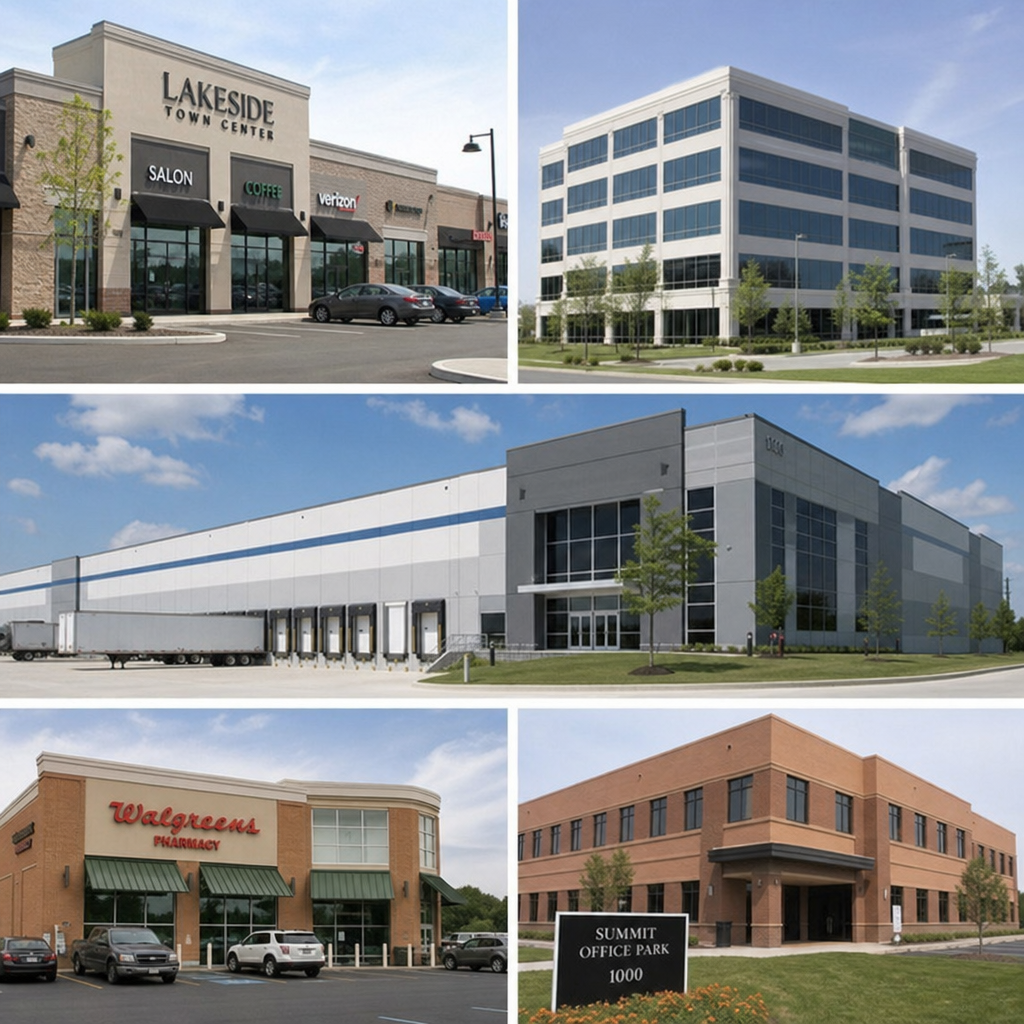
Here are the primary commercial asset classes:
Retail: Properties ranging from single-tenant standalone buildings (like a pharmacy) to large strip malls and shopping centers.
Office: These can be single-tenant buildings, suburban mid-rise structures, or massive downtown skyscrapers.
Industrial: This includes manufacturing facilities, distribution centers, and flex spaces.
Multi-family: Apartment complexes containing five or more units.
Special Purpose: Properties designed for a specific use, such as hotels, car washes, or self-storage facilities.
When diversifying a real estate portfolio , investors often weigh the pros and cons of different assets. For example, a common debate is multi-family vs industrial warehouse investments. Multi-family properties offer stability because people will always need a place to live, making them highly resilient during economic downturns. Conversely, industrial warehouses have seen explosive growth due to the boom in e-commerce and logistics. Industrial spaces typically require lower maintenance and offer longer lease terms, though they can be more sensitive to supply chain fluctuations than apartment buildings.
Essential Property Investment Strategies
Success in commercial property investment relies heavily on choosing the right strategy for your goals, capital, and risk tolerance.
1. Active vs. Passive Investing
If you want total control and maximum returns, buying commercial property directly is the way to go. You can choose a 'value-add' strategy, where you purchase an underperforming property, renovate it, increase the rent, and force appreciation.
However, if you prefer a hands-off approach, you can still participate in the market. Generating passive income from REITs (Real Estate Investment Trusts) is an excellent alternative. REITs allow you to buy shares in a company that owns and operates income-producing commercial real estate, offering liquidity and high dividend yields without the headache of property management.
2. Focusing on Long-Term Tenants
One of the best property investment strategies involves targeting properties that offer stable, long-term tenancy in commercial real estate. For instance, medical offices and national retail chains rarely move because the cost of relocating their infrastructure is too high.
Mastering the Financial Metrics
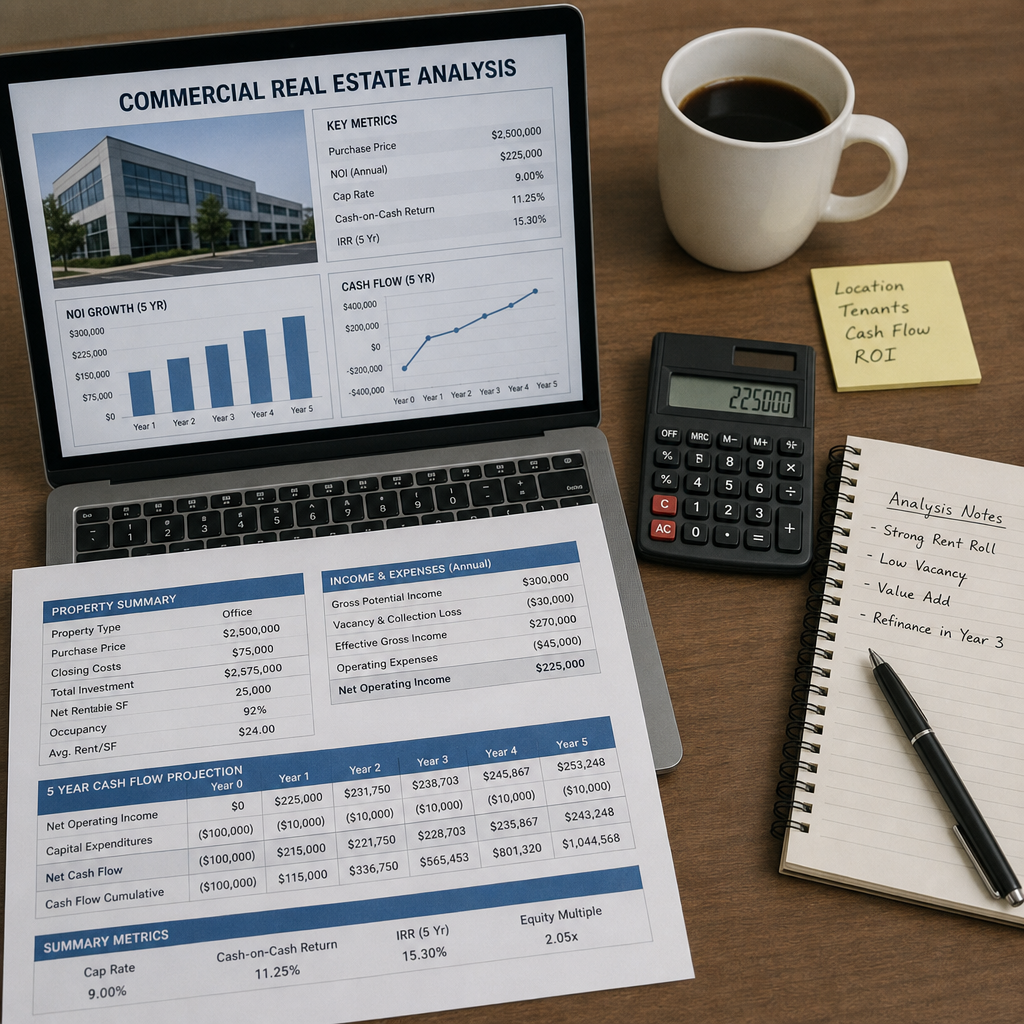
To thrive in real estate investment, you have to speak the language of numbers. Unlike residential properties, which are often valued based on comparable sales in the neighborhood, a commercial investment property is valued based on the income it generates.
Here are the critical metrics you must master:
Calculating Net Operating Income (NOI)
Calculating net operating income is the foundation of commercial real estate valuation. NOI is simply your property's gross operating income minus its operating expenses (such as property management fees, insurance, property taxes, and maintenance). Note: NOI does not include your mortgage payments or income taxes.
Understanding Capitalization Rates
Once you have your NOI, you can determine the property's yield by understanding capitalization rates (commonly known as Cap Rates). The formula is simple: Cap Rate = NOI / Property Value. If a building generates $100,000 in NOI and costs $1,000,000, the cap rate is 10%. Cap rates help you quickly compare the potential returns of different properties across different markets. A lower cap rate generally indicates lower risk (and higher property value), while a higher cap rate suggests higher risk but greater potential returns.
Financing Your Investment
A major hurdle for newcomers is figuring out how to finance a commercial building. Commercial loans are fundamentally different from residential mortgages.
When buying commercial property and securing a loan, commercial mortgage interest rates are typically slightly higher than residential rates. Furthermore, the terms are different. While you might get a 30-year fixed-rate mortgage on a house, commercial loans often operate on a 5-to-10-year term with a 20-to-25-year amortization schedule. This means your payments are calculated as if the loan spans 25 years, but the remaining balance (a balloon payment) is due at the end of the 5 or 10-year term, requiring you to refinance or sell.
When evaluating your loan application, lenders spend a great deal of time analyzing debt coverage ratio (DSCR). The DSCR measures a property's ability to cover its debt obligations using its operating income. The formula is NOI / Annual Debt Service. Lenders generally look for a DSCR of 1.20 or higher, meaning the property generates 20% more income than is required to pay the mortgage.
The Acquisition Process and Risk Management
Acquiring a commercial investment property is a complex process that demands extreme diligence and strategic foresight.
Conducting Due Diligence
Never rush a commercial purchase. Conducting commercial due diligence is an intensive process that involves verifying every aspect of the property. This includes:
Financial Audits: Reviewing past tax returns, utility bills, and existing tenant leases to ensure the stated income is accurate.
Physical Inspections: Hiring structural engineers, roofers, and HVAC specialists.
Environmental Studies: Conducting Phase I Environmental Site Assessments to ensure the land isn't contaminated, which is a crucial liability check in commercial real estate.
Market Analysis
Alongside physical inspections, comprehensive commercial real estate market analysis is vital. You need to understand the local demographics, traffic counts, zoning laws, and economic drivers. Are major employers moving into the area? Is the local population growing? A thorough market analysis ensures you are buying in an area with a trajectory of growth.
Lease Structures and Mitigating Risk
One of the most attractive aspects of owning commercial real estate is the favorable lease structures. Understanding the triple net lease benefits (NNN) can completely change your investment trajectory. In a triple net lease, the tenant is responsible for paying not only the base rent but also the property taxes, building insurance, and maintenance costs. This essentially creates a frictionless, passive income stream for the landlord, insulating you from unpredictable spikes in operating expenses.
However, risks still exist. For example, mitigating vacancy risk in retail requires a proactive approach. If you own a strip mall, losing a tenant can drastically impact your NOI. To mitigate this, savvy investors focus on securing an 'anchor tenant'—a large, well-known brand (like a major grocery store) that draws consistent foot traffic to the center. Additionally, staggering your lease expiration dates ensures that all your tenants don't move out in the same year, protecting your cash flow.
Unlocking Powerful Tax Advantages
One of the greatest wealth-building secrets in real estate investment is the favorable tax code. Commercial properties offer substantial depreciation deductions, allowing you to legally offset a significant portion of your rental income, thereby lowering your tax burden.
Even more powerful are the tax advantages of 1031 exchanges. Named after Section 1031 of the IRS tax code, this strategy allows an investor to sell a commercial property and reinvest the proceeds into a new 'like-kind' property, thereby deferring all capital gains taxes. By continually utilizing 1031 exchanges, you can upgrade from smaller properties to larger, more lucrative assets over your lifetime, allowing your wealth to compound tax-free. Eventually, under current tax laws, your heirs can inherit the property with a 'stepped-up' basis, potentially wiping out the deferred taxes entirely.
Related Exity resources
Businesses for sale (including Melbourne)
FAQ and Contact us
More guides in the Exity blog, including How to buy a business in Australia and Broker vs online marketplace
Conclusion
Stepping into the world of commercial real estate is a transformative move for any ambitious investor. By clearly understanding what drives property value—such as calculating net operating income and understanding capitalization rates—you can easily separate a mediocre deal from a highly profitable one.
Whether you are navigating the differences between multi-family vs industrial warehouse assets, structuring a bulletproof triple net lease, or simply reaping the tax advantages of 1031 exchanges, a well-managed commercial investment property is one of the most reliable vehicles for generational wealth creation. Take your time, focus heavily on conducting commercial due diligence, and align your purchases with a clear, long-term strategy. The robust returns and stable cash flow of the commercial market await you.
Q&A
Question: Is commercial property a good investment compared to residential?
Short answer: Yes, if you understand the landscape. Commercial assets typically have longer leases (often 3–10 years), creating more predictable cash flow and a more professional landlord-tenant dynamic because tenants are businesses with a stake in maintaining the property. While the upfront capital is higher than for most residential deals, the return on investment is traditionally higher, making commercial property a strong vehicle for long-term wealth.Question: Which financial metrics matter most, and how are commercial properties valued?
Short answer: Value is driven by income. Start with Net Operating Income (NOI), which equals gross operating income minus operating expenses (management, insurance, property taxes, maintenance). NOI excludes mortgage payments and income taxes. Use the capitalization rate (Cap Rate = NOI / Property Value) to gauge yield and risk. Example: $100,000 NOI on a $1,000,000 property equals a 10% cap rate. Lower cap rates signal lower risk/higher values; higher cap rates imply higher risk and potential returns.Question: How are commercial investments financed, and what is DSCR?
Short answer: Commercial loans usually carry slightly higher rates than residential mortgages and often feature 5–10 year terms with 20–25 year amortization, ending in a balloon payment that typically requires refinancing or selling. Lenders focus on the Debt Service Coverage Ratio (DSCR = NOI / Annual Debt Service) to ensure the property’s income covers debt; a DSCR of 1.20 or higher is commonly required.Question: What does smart acquisition and risk management look like, and how do lease structures help?
Short answer: Conduct thorough due diligence: verify financials (tax returns, utility bills, leases), complete physical inspections (structure, roof, HVAC), and perform environmental studies (such as a Phase I Environmental Site Assessment). Pair this with market analysis (demographics, traffic counts, zoning, economic drivers). Lease structures can further reduce risk, triple net (NNN) leases shift property taxes, insurance, and maintenance to the tenant, stabilizing your expenses. To mitigate vacancy risk in retail, secure an anchor tenant to attract foot traffic and stagger lease expirations to avoid multiple vacancies at once.Question: What are the key tax advantages of commercial real estate?
Short answer: Commercial properties offer substantial depreciation deductions that can offset rental income and reduce taxes. Additionally, 1031 exchanges allow you to defer capital gains by reinvesting sale proceeds into a like-kind property, enabling you to trade up and compound returns tax-deferred. Under current laws, heirs may receive a stepped-up basis, potentially eliminating deferred gains altogether.